
 Angles & Flats


 Beams & Pipes


 Plates


 Surface treatment


 Robotic welding

 Software
 Presses


 Shearing


 Sawing


 Automation

 Contact us
 Find a machine
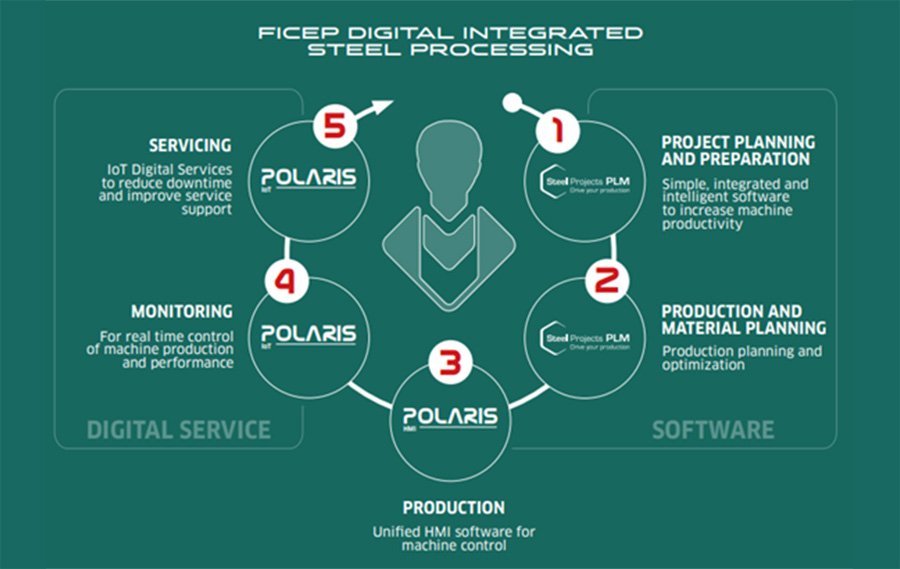
The rapid advancement of Industrial Internet of Things (IIoT) technologies has transformed the way industrial machinery operates and is monitored. IIoT refers to the interconnection of industrial machines, devices, and sensors via the internet, enabling them to collect and exchange data for analysis and improved decision-making. The objective of these technologies is to enhance flexibility, efficiency, and productivity while lowering production costs by providing predictive insights and facilitating real-time decision-making.
FICEP is also investing in IoT technologies to acquire this strategic asset, gain a deeper understanding of customer usage patterns, and generate value-added services. This investment forms the basis for asset servitization, where equipment and machinery are treated not just as products but as services that offer continuous value through data and analytics.
The development process for the new IIoT platform has been organized into four key phases:
Monitoring
: This phase focuses on the digitalization of individual machines to enable comprehensive monitoring by integrating advanced technologies and software solutions.Service:
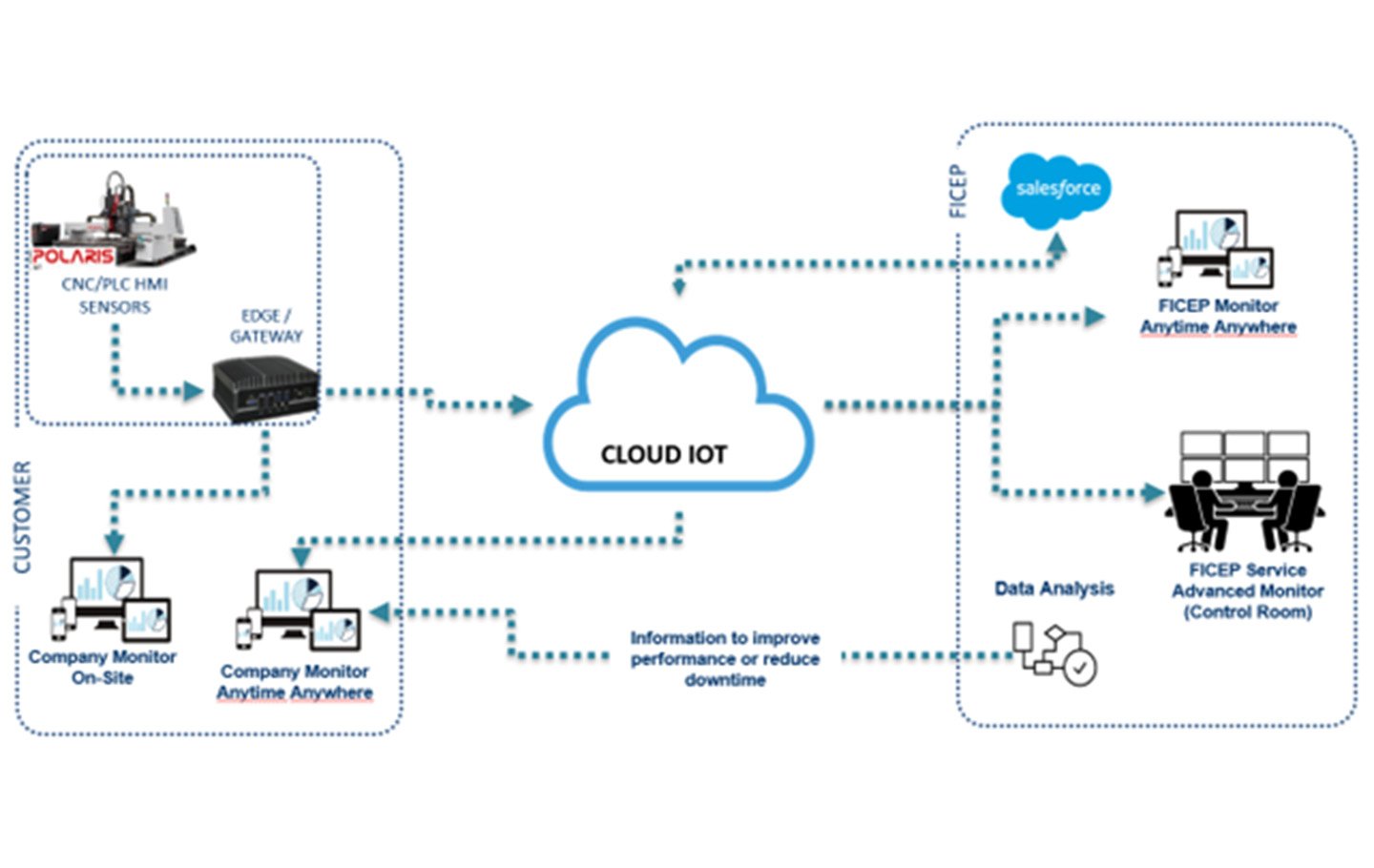
During this phase, the service is launched for customers. More data is collected, and insights into machine status are enhanced using telemetry data and traditional data analysis techniques.Machine Learning:
Here, the data collected from machines is analyzed using statistical and machine learning algorithms. These models are designed to predict potential issues such as downtime, malfunctions, and underperformance, enabling timely interventions. Historical data also supports the development of additional assistance procedures and self-diagnosis tools, which help operators and FICEP technicians resolve problems more efficiently.Business Integration:
The monitoring system is integrated with FICEP’s management systems, allowing the company to maximize the value of collected data across various business activities. This includes opportunities for upselling and cross-selling, automating the reordering of spare parts, and generating tickets for service requests. Moreover, data and insights can be shared with third-party systems, enhancing overall service offerings and business operations.
In general, the project aims to improve customer support by shifting from reactive to more efficient, preventive, and predictive maintenance models. This shift is driven by data analytics, which provide deeper insights into machine health, performance, and potential issues. The outcome is better services, a clearer understanding of machine usage, reduced downtime, and increased customer satisfaction.
Another key component of this project is consumption monitoring, which tracks different types of consumption to calculate costs and implement reduction strategies. This is crucial for determining the carbon footprint of unit machines and Industry 5.0.
One of the main objectives of Industry 5.0 is to reduce energy consumption in production facilities. The first step toward this goal is through monitoring, which helps raise awareness of energy use. By visualizing the data, customers can pinpoint opportunities to optimize energy consumption and lower operational costs. Further analysis by FICEP could provide insights or recommendations for additional energy savings.
Get in touch with our experts and unlock the potential to revolutionize your production!
Photo gallery


Questions?
For any question, request or proposal, please do not hesitate to write us
or book one online appointment with one of our experts.


