
 Angles & Flats


 Beams & Pipes


 Plates


 Surface treatment


 Robotic welding

 Software
 Presses


 Shearing


 Sawing


 Automation

 Contact us
 Find a machine
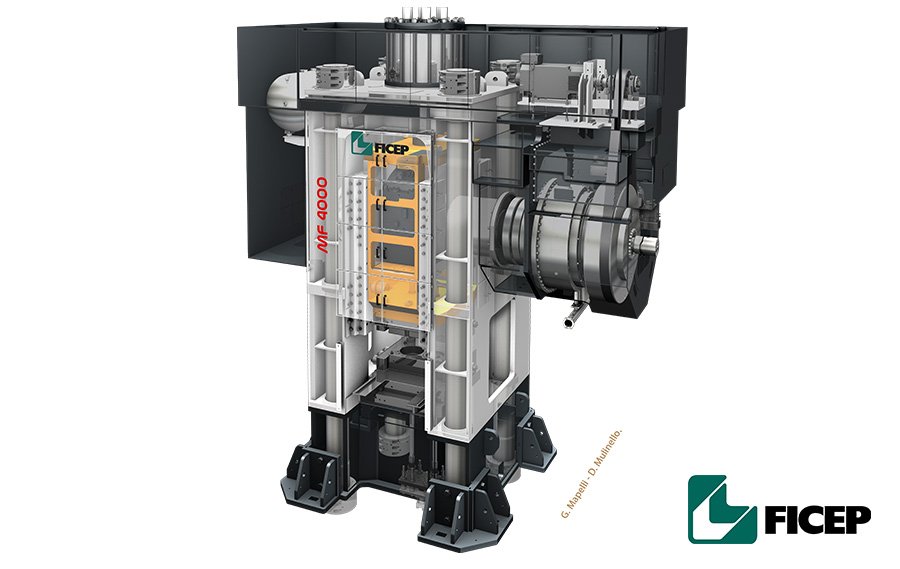
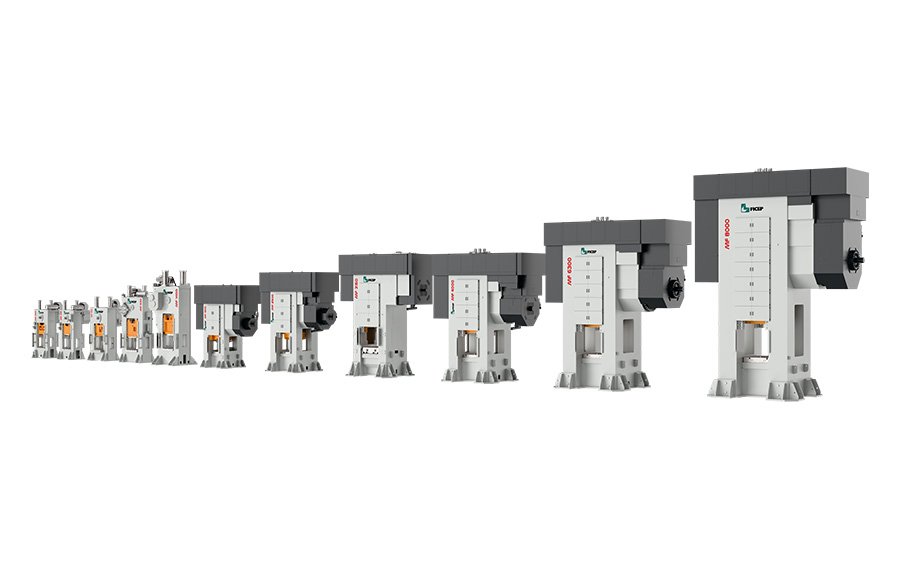
FICEP has established itself as a unique supplier in the hot forging sector, covering all stages of the process: from cutting to the various types of presses (preforming, forging, deburring), integrated into modern automation systems. The company has developed its product lines both horizontally, to cover the entire process, and vertically, enriching its machine families with ever new and high-performance models. One example is the ever-expanding MF series of mechanical presses, which now offers a force range from 250 to 8,000 tons. The larger models, MF6300 and MF8000, are currently under development. The MF4000 is one of the latest additions, a technologically advanced solution that combines productivity, reliability and above all quality repeatability.
Robust and Precise Structure
Designed to smoothly handle hot forging of ferrous and non-ferrous materials (steels, aluminum alloys and titanium), the MF4000 press finds easy application in sectors such as automotive, energy and gear manufacturing. Designed for high production, it is equipped with technological devices that enable rapid re-tooling, making it suitable even for medium-volume lots with more frequent production changes. Considering the nominal force of 40,000 kN, each element has been appropriately sized to ensure the right level of rigidity and to better distribute the working stress, optimizing material use and containing deformation and thermal expansion.
State-of-the-art transmission and maximum energy efficiency
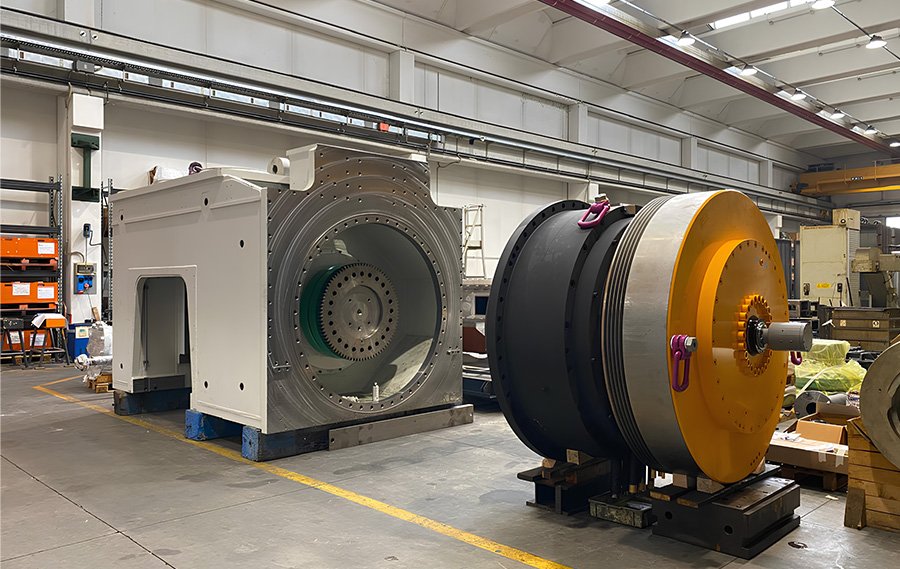
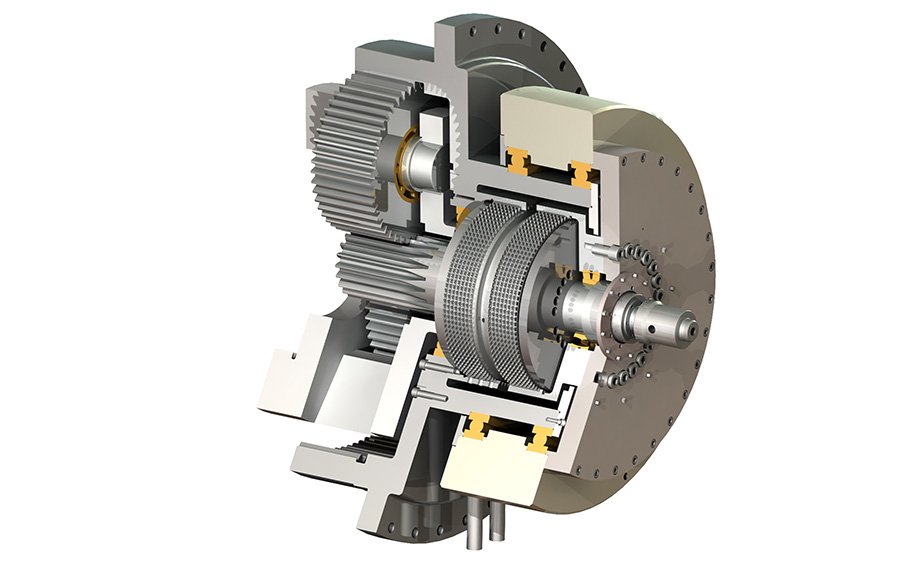
Among the most value-added technical solutions of the MF4000 press is the motion transmission system. The press is also equipped with centralized grease and oil lubrication systems for all internal mechanisms.
Maximum energy efficiency
FICEP pays close attention to energy efficiency. The MF4000 is an example of this, thanks to a technology that uses the braking phases of the ram to recover energy, providing savings ranging from 10 % to 40 % depending on the application. Specifically, a torque motor connected to the eccentric shaft allows the ram to be stopped at the Upper Dead Point using the motor as a generator, avoiding energy dissipation in the form of heat, typical of traditional braking systems. This energy can be fed back into the circuit or returned to the main motor. Finally, lower and upper ejector assemblies consisting of hydraulic or electrohydraulic cylinders are included to eject the workpiece.
Integrated automation, IoT, digital twin and security
Configuration options for the MF4000 press include the integration with automation systems to facilitate its inclusion in complex production lines. Typically, there is a preforming press upstream and a deburring press downstream. Material handling, die lubrication, and ancillary tasks are often handled by anthropomorphic robots. For maximum productivity, press and robot move in perfect synchrony. The ability to manage the entire system through the MF4000’s PLC is an advantage, as Ficep software can manage the single machine or act as a supervisor of the entire line.
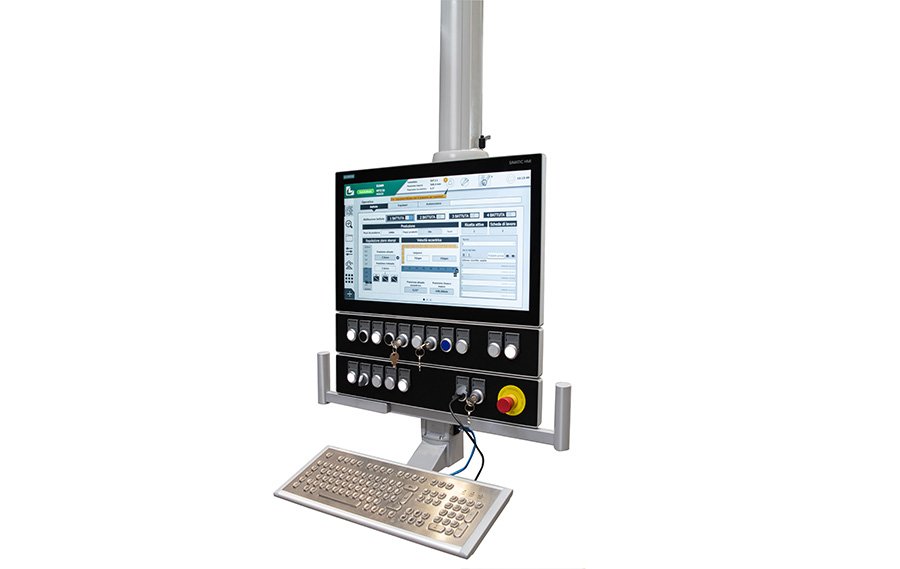
The digital tools developed by FICEP and made available to the customer make it possible to take advantage of a digital twin to simulate and optimize the work cycle of the press and the entire production line, both at the design stage and during after-sales service. The status of each machine is constantly monitored by sensors. An on-site computer saves the collected data, making it available for cloud-based analysis; artificial intelligence algorithms identify variations useful for predictive maintenance and adaptive PLC control, in accordance with state-of-the-art IoT. Mold opening and closing movements are synchronized with robot loading and unloading activity to operate safely and reduce downtimes. Everything is manageable by a single Ficep software environment, with a highly usable human-machine interface, allowing machine and robot management even without skilled technicians.
Simplified maintenance
Although highly automated, the MF4000 requires operator interventions for control and maintenance. Ficep developed the press paying attention to these aspects. The upper part of the machine has a structure accessible by external ladder or aerial platform, allowing the operator to safely intervene on the organs in the upper area of the press (motor, flywheel, belt, balancing cylinders, lubrication systems). Components and utilities have been designed and positioned to simplify maintenance operations, which also take place with digital support, thanks to the PLC with a simplified interface and a dedicated troubleshooting section.
Photo gallery


Questions?
For any question, request or proposal, please do not hesitate to write us
or book one online appointment with one of our experts.


