
 Angles & Flats


 Beams & Pipes


 Plates


 Surface treatment


 Robotic welding

 Software
 Presses


 Shearing


 Sawing


 Automation

 Contact us
 Find a machine
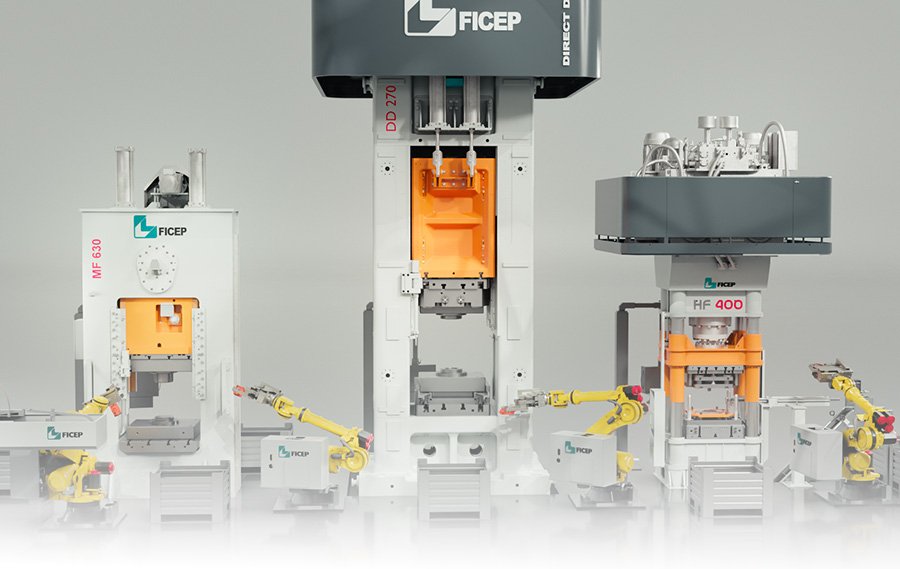
There is much discussion about automation in the forging industry. However, your plan to invest in the latest automation doesn’t start by simply saying, “I want a new press,” or “I want automation”. The correct way to plan for your automated forging cell is not about replacing the equipment you have, but to reevaluating your entire forging process.
CONSISTENCY IN PRODUCTION
Investing in an automated forging cell ensures precise, high-speed production with control over every step of the forging process. This is essential for hot forging, where temperature loss is an issue.
Preforming, forging and trimming follow fixed cycles to maintain the correct part temperature. Automation also adds flexibility, allowing adjustments like controlled cooling before trimming to prevent deformation and ensure consistent results.
INCREASED ACCURACY
To stay competitive in the world market, leading forging producers look to our engineers for ways to improve their forging process. At FICEP, we identify automation solutions that provide the highest productivity, efficiency and quality for the final part. Using 4-axis robots or 6-axis robots for repetitive functions combined with vision systems, scales, lasers and sensors provides for accurate checks throughout the production process.
For example, we improve production quality at sawing by using lasers to mark billets. This process is particularly valuable when bars are cut in a separate area from the forging process and stored until needed. A camera on the conveyor checks the barcode on each billet before it enters the induction heater, ensuring the correct billet is sent to the forging cell. This automated verification reduces errors and increases accuracy.
RELIABLE TRACEABILITY
Traceability is a key challenge in forging, especially for automotive, aerospace, and medical sectors. Laser codes marked on parts for identification enabled to track and resolve defective parts efficiently. This is another application of automation that saves time and money and maintains customer trust.
AUTOMATED INTEGRATION AND YOUR WORKFORCE
With integrated automation, your operator sets up the forging cell locally – at the cell – but can oversee the production process of the forging cell remotely. This remote-control room in your plant is where the operator manages a dedicated PC to collect information of every single press, robot and weighing system in the forging cell.
PC is a process control center connected to your plant’s ERP system and the data collected is used to optimize your productivity, product quality and the life of the machines in your forging cell. The PC is different than the PLC, which is the master control of the forging process located at the cell. The remote PC collects all the data from the PLC, then stores and interprets the data for the operator to effectively monitor production and maintain the forging cell. The operator is also needed to run the PLC and safely activate the forging cell. Once the forging cell is activated, the operator returns to the remote PC to monitor the forging production.
IMPROVED PRODUCTIVITY, QUALITY AND EFFICIENCY
Sensors installed into the integrated automated forging cell assist the operator to effectively monitor the forging process. This is particularly essential in the hot forging process. Using a printer connected to the PC, the operator prints and applies a label on each bin of good parts, scraped parts, rejected parts, or billets that are just a little low in temperature. Integrated automation helps you reduce waste, because you can reuse those billets.
If the forging cell stops for any number of reasons, the billets exiting the induction heater will be automatically counted and directed into a bin for future reuse. If there is a failure of the induction heater, and the billets are overheated, these pieces are counted and ejected into a scrap bin. The system will generate bin labels showing how many billets are in each bin and which billets are rejected, reusable or good forged parts.
PROTECTING YOUR INVESTMENT
Sensors are essential for ensuring each press operates correctly. Our Siemens software monitors critical data to predict failures early. Temperature sensors on FICEP shears detect heat that can cause wear, enabling preventative maintenance. With FICEP Teleservice, engineers can remotely track sensor data and deliver preventive and predictive support.
THE IMPORTANCE OF PREVENTATIVE MAINTENANCE
Automated forging cells maintain the highest standards of preventative maintenance. Programming consistent routine maintenance makes your forging cell reliable. Industry 4.0 is the standard for forging producers to operate their machines efficiently at their optimal condition. You will have a lower cost and shorter downtime when you schedule maintenance instead of forging with a worn or damaged machine or stopping production in the middle of a job.
It is important to understand that integrated automation is not a matter of adding a robot to perform a single step in the production process. It is a series of mechanisms engineered to take the entire forging process to the highest level of productivity.
Photo gallery


Questions?
For any question, request or proposal, please do not hesitate to write us
or book one online appointment with one of our experts.


