
 Angles & Flats


 Beams & Pipes


 Plates


 Surface treatment


 Robotic welding

 Software
 Presses


 Shearing


 Sawing


 Automation

 Contact us
 Find a machine

In an exclusive interview with International Sheet Metal Review, the leading UK magazine for the steel construction sector, our CEO Christian Colombo shares into the company’s latest advancements, including a strong focus on laser cutting technology and the successes achieved.
Colombo highlights how FICEP is pushing the boundaries of innovation and expanding its global presence to better serve the evolving needs of the industry.
Read on to explore how FICEP is shaping the future of steel construction with cutting-edge solutions
ISMR: Please outline any recent successes or achievements for FICEP Group?
CC: We have registered record sales now for the third year in a row. Last year, we made 20% more sales than the year before. This year, it will also be a record year (15% more sales than last year). We are competing in a more aggressive market, which offers lots of solutions, but our strategy has always been to provide a process for our customers. Our customers typically are steel construction builders (transmission towers, buildings, bridges etc.). We try to supply them with every working unit to enable them to make their products. This includes shot blasting (cleaning materials); drilling, sawing and milling beams and secondary components (like gratings and gusset plates). We then allow them to coordinate the assembly of these components, providing elements such as shot blasting and painting so that products can go straight onto the truck. Our great success is that we can now fulfil all the processes needed (including painting, robotic welding etc.). Customers don’t just want cutting operations; other machining operations (such as drilling, marking, milling etc.) are needed, so all our machines offer extra functionality. That can mean cutting with laser, plasma or oxyfuel with drilling and milling on top, to offer flexible operations. At the same time, I am proud to confirm that we are continuing to develop our product lifecycle management software. We are now integrating capabilities with process simulation so that customers know how much time it will take to finish a job. We are integrating more and more assets in the workshop, even manual operations, to enable traceability and match it to the scheduling. We can also integrate our machines with IoT devices to collect data on energy and gas consumption, as well as operating costs in general.
We wish to fulfil all the value streams of our customers to make them as efficient, while we develop our own value streams. This applies to all operations, not just to machine delivery, but to pre-sales activities, feasibility and simulation studies, project management and follow-up after delivery with consultancy on lean management etc. to customers. It is a continuous process. This involves a lot of investment on our side: increasing capacity and investing in new machinery and systems. We installed a large Mazak FMS (possibly the biggest in Europe) on our production line that works automatically 24 hours per day, seven days per week. We are very vertically integrated and tend to design and manufacture our own components. We buy in some hydraulic, electrical and pneumatic components but, in general, our own technical and service engineers can work in the same manner on every asset with no need to specialise on particular technologies.
ISMR: Where do you see areas of growth and opportunity for manufacturers?
CC: We are living in difficult times with two wars in Ukraine and Gaza that will not finish quickly. It is difficult to predict the oil price but my feeling is that areas of continuing development will be in Europe. Europe has a very ambitious plan, the Green Deal, that dictates how a machine/product is designed from an energy-monitoring and sustainability standpoint. At this point, risks from conflict and possible oil price rises make it difficult to see whether some of these ambitious sustainability targets can be reached. Having said that, I think that Europe should find a way to stimulate and incentivise manufacturers to tread this path. It should not just be because “we need to be greener.” For example, Europeans have a lot of installed machines that are old. Perhaps the European Community could consider, in view of continuing competition from the Far East, offering European manufacturers the option to buy back older machines instead of giving out a grant, or even contribute to the trade-in purchase or incentivise companies to retrofit older machines so that they can be re-sold into the market. This sustainable business model could give machinery builders in Europe an incentive to be different from everyone else and compete on new terms with far Eastern manufacturers.
North America is an important part of our business, representing 30 per cent of where we sell. Europe is still 40% of our market and the rest is outside Europe. The Italian market is growing strongly but I see the greatest growth to come in the Middle East (from structural steel markets etc.).
ISMR: Please explain your strategic and technical focus/vision over the next few years?
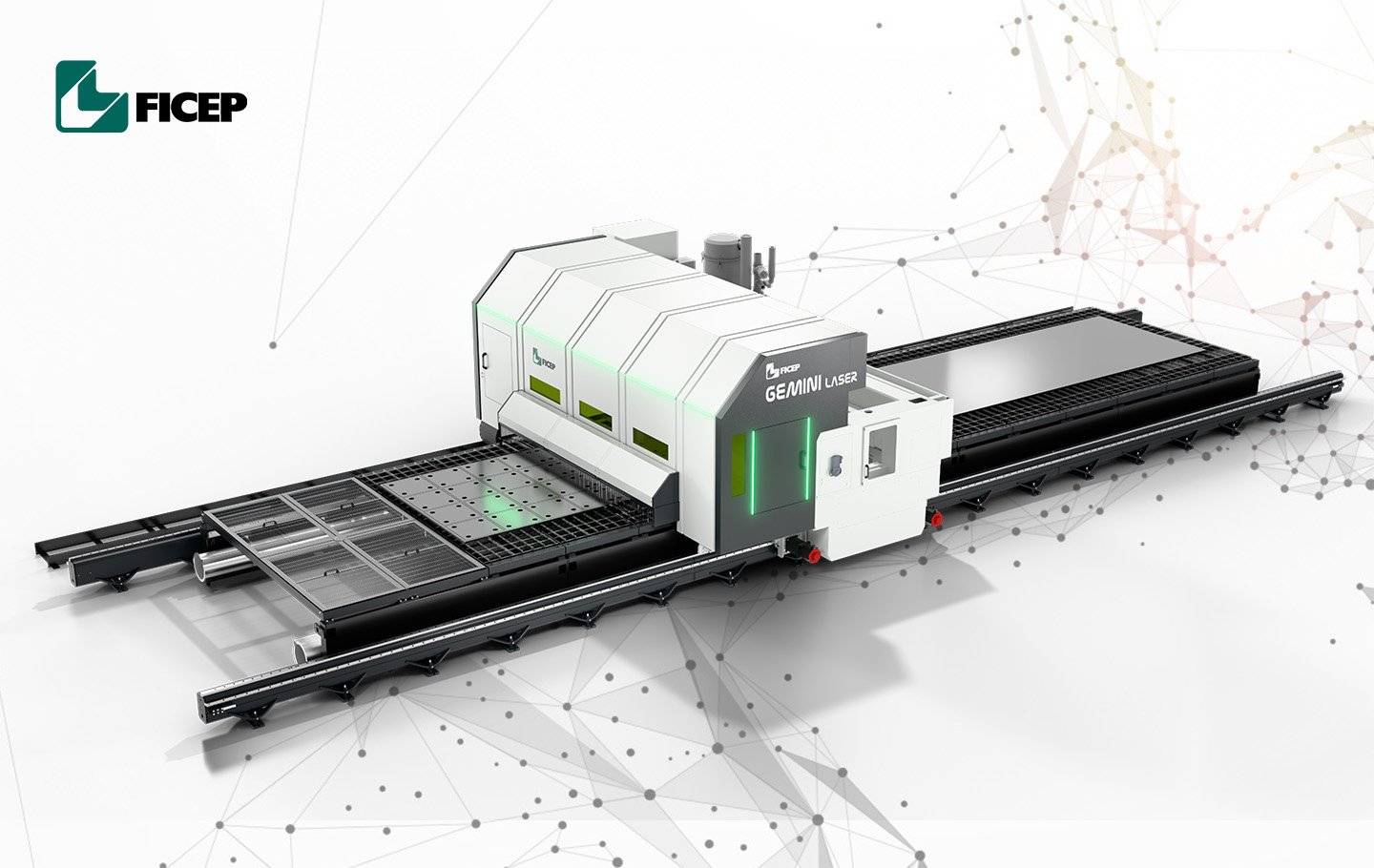
CC: Laser is a strong technical focus for us, and a challenge. We already offer machines with laser-cutting capabilities. From a strategic standpoint, we are developing new machines and technologies and getting closer and closer to our customers by opening subsidiaries in important markets. We are increasing our direct presence in North America. We just opened our subsidiary in Canada so now we can offer direct sales and service in the USA and Canada. We also opened a new subsidiary in Mumbai, India, this October with 16 people. Japan is an important market for us and we have just increased the size of the company that we opened there seven years ago. We are putting a lot of effort into that market. Japan is the biggest consumer of steel per capita in the world; it consumes six million tons per year (structural steel construction).
ISMR: What is your approach to technologies such as Artificial Intelligence (AI)?
CC: We started a major AI project a few years ago. There are different ways of using AI so we started from the standpoint of the user experience (not just the machine operator but all the stakeholders i.e. the maintenance guys, the owners, the service engineers etc.). When you design a machine that takes on all these personas, you need to understand how it will help them all to do their job properly, as well as collecting data from the machine so that the OEM can provide service to whoever has to use the asset. This meant that we had to manage an entirely new digital innovation project. It was a success and we recently rolled out, to all our subsidiaries, a new service management software device that is the same platform we now use for sales and e-commerce. It collects a huge amount of data during an intervention for service support or training (i.e. emails, photos, phone calls, video calls etc.). Collecting all this data in an intelligent manner, as well as data from machines, and then putting it all together can generate valuable troubleshooting help that is meaningful to whoever needs to use it. This was a major project for us to undertake, with a lot of players, but it has created a new way of working for us. We chose key partners for the project and are now offering this feature to all our customers. It also obliged us to develop new sensors to collect data such as vibration, noise, temperature, quality of oil etc, so that we could add machine-learning algorithms and then generate data that is useful in the cloud from our service management solution. It’s a huge project that took a couple of years and we are now finishing the rollout to our customers.
ISMR: How are you handling sustainability in both your products and organisation (including carbon footprint calculations etc.)?
CC: On the operational side, you must measure where you are consuming your energy and calculate your CO₂ footprint. We are currently halfway through a solar panel installation that should be finished by the middle of next year. We are also adding monitoring devices to help us understand if certain types of jobs are more suited to night shift or day shift work, so that we can optimise our CO₂ footprint. From a product perspective, we are adding IoT devices to our machines to help our customers. However, I believe that there should be help for European manufacturers to define an ‘Eco label’ for their products. If you can verify that your machine has been sustainably produced, then that machine should attract a premium. This would create a whole ecosystem of suppliers/supply chain that would be part of this measuring and monitoring initiative and could create a new way of making companies ‘greener’. It is a very ambitious project but it is important to create incentives in unstable times. From a product standpoint, we can define the CO₂ impact of the machine while it is in operation and assign that to a single part. We can then apply 4D or 5D VIM modelling and use the 3D collaboration tool by colouring the objects in different colours, according to the CO₂ impact budgets provided to a customer. We have also designed our machines to take account of key energy savings. Revolutionary machines, such as Ficep Direct Drive presses, are proof of this if you look at their power consumption and productivity performance.
We would like to extend our heartfelt thanks to Mr. Bobby Bagha and the ISMR team for this opportunity to share FICEP’s journey and vision with their esteemed audience. It was a pleasure to discuss our innovations and strategic focus, and we look forward to continuing this dialogue as we shape the future of the steel construction industry together.
Photo gallery




Questions?
For any question, request or proposal, please do not hesitate to write us
or book one online appointment with one of our experts.


